
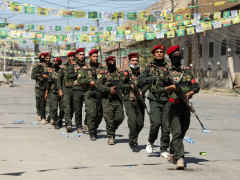

When Syria’s civil conflict ended in December 2024 with the fall of Bashar al-Assad’s regime, hundreds of thousands of citizens were still bearing arms. Throughout the nearly 14 years of war, armed factions proliferated: from the broad spectrum of armed opposition factions in the northwest and the regime’s array of military and militia forces in central and western Syria, to the Syrian Democratic Forces (SDF) in the northeast and a complex network of militias throughout the south, and not to forget the likes of ISIS and al-Qaeda.
In this context, the task of demilitarising society and reunifying the country has posed a truly formidable challenge for Syria’s transitional authority. Indeed, the process of disarming, demobilising, and reintegrating armed groups while simultaneously establishing new armed forces and a reformed security sector stands at the core of Syria’s transitional state building project. Days of heavy conflict between government forces and the SDF in Aleppo this past week highlighted the consequences of a failure to resolve the integration challenge.
As a first step in December 2024, the al-Assad regime’s armed forces were swiftly dissolved and a process of status settlement was initiated, whereby all previous soldiers – both officers and conscripts – could register using their national ID and apply for release to civilian life or to re-enlist in the new army.
Thousands of men chose to undertake this settlement process across the country, to clear their names and start life anew. But thousands of others abstained, especially in the coastal region, where the Alawite minority dominates. While many of those who avoided the process melted back into rural communities, hundreds ended up forming anti-government factions that conducted low-level attacks on government forces, culminating in a huge coordinated campaign on March 6 that killed more than 100 government personnel – triggering a chaotic and brutal week of violence that left more than 1,000 people dead.
In the months since, several thousand former regime personnel have undergone training and joined Syria’s new security forces across the country. Nevertheless, the fighting persists, due in part to financial support from prominent al-Assad regime figures now in exile in neighbouring Lebanon, as well as in Russia.
That continues to undermine Syria’s ability to heal ties with Lebanon and Russia, but also complicates the geopolitical standing of such countries among the wider region, which has stood squarely behind the new government in Damascus in the hope of transforming Syria into a base of stability and prosperity.
Meanwhile, Syria’s transitional government is also seeking to rebuild the Ministry of Defence (MOD) with an army, navy and air force and the Ministry of Interior (MOI) with provincial public security directorates, and dedicated “counterterrorism”, counternarcotics and cyber forces.
In this transitional phase, the MOD has emerged as the umbrella under which the broad spectrum of opposition armed factions have been folded. While all former opposition groups have technically dissolved, some remain largely in form, constituting the army’s nearly 20 divisions. Those factions with longstanding ties to Turkiye – particularly from the northern Aleppo-based Syrian National Army (SNA) – appear to have benefitted from greater levels of military support and arms supplies than others previously based in Idlib. Some have leaders with controversial pasts, including outstanding international sanctions designations for violent crimes and corruption.
In the earlier phases of Syria’s transition, the MOD was the force tasked with responding to securi