
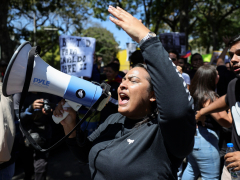

Protesters have marched in duelling demonstrations in Venezuela’s capital, Caracas, as the country’s National Assembly weighed a bill that would grant amnesty to political prisoners.
The demonstrations on Thursday marked Venezuela’s National Youth Day and were the first major showing of opposition to the government led by interim President Delcy Rodriguez.
Recommended Stories
list of 3 items
- list 1 of 3Venezuela rearrests opposition figure Guanipa after release: Prosecutor
- list 2 of 3Latin America: In the Shadow of the US | Ep 1 – Coups
- list 3 of 3US seizes Venezuela-linked oil tanker in Indian Ocean
end of list
She has led the country since the United States abducted Venezuelan President Nicolas Maduro in January.
Her government called on its supporters to flood the streets with counterprotests, and both rallies attracted thousands of people.
The show of defiance came as the National Assembly debated a landmark bill that would grant amnesty to political prisoners detained under Maduro.
A final vote on the bill has been postponed, despite government statements previously indicating that it would be passed this week.
Rodriguez has overseen the release of hundreds of political prisoners since taking office, in what has been seen as one of several concessions to the administration of United States President Donald Trump.
Other moves have included staunching Venezuelan oil deliveries to Cuba and passing legislation to open the country’s state-controlled oil industry to more foreign companies.
An amnesty for political prisoners has long been a central demand of the opposition and human rights organisations.
However, critics have raised concerns over how the legislation, if passed, would be implemented and who would be eligible for release. The bill has not yet received a public reading.
Rodriguez had announced the amnesty legislation last month, saying it was designed “to heal the wounds left by the political confrontation fuelled by violence and extremism”.
She said it would cover what she described as the “entire period of political violence from 1999 to the present”.
The amnesty bill covers charges of treason, terrorism and spreading hate that were used to lock up dissidents over the past two decades.
It would not apply to those convicted of murder, drug trafficking, corruption or human rights violations, according to media reports about the legislation.
Alex Neve, a member of the United Nations’ Independent International Fact-Finding Mission for Venezuela, said earlier this week that the bill “offers an opportunity to provide justice and alleviate the suffering of the many people who have been unlawfully detained for political reasons in Venezuela”.
However, Neve said that transparency was essential, and civil society groups “must be at the centre of this process”.
Already, human rights groups have questioned the Rodriguez government’s efforts to free political prisoners.
The Venezuelan-based human rights group Foro Penal has conf