
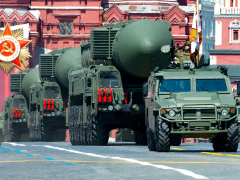

Both Beijing and Moscow expressed their regret at the lapse of the last Russia-US nuclear arms control treaty.
Published On 5 Feb 2026
The Kremlin says Russia will continue to be a responsible nuclear power, despite the expiry of the last nuclear arms control treaty between Moscow and Washington, which experts say risks ushering in a new global arms race.
The New START treaty expires on Thursday, marking the end of more than half a century of limits on the United States and Russia’s strategic nuclear weapons.
Recommended Stories
list of 3 items
- list 1 of 3Russia ready to respond to any US weapons deployment in Greenland: Ryabkov
- list 2 of 3US envoy Witkoff says Ukraine talks with Russia ‘productive’
- list 3 of 3China pitches itself as a reliable partner as Trump alienates US allies
end of list
“Today the day will end, and it [the treaty] will cease to have any effect,” Kremlin spokesperson Dmitry Peskov told reporters on Thursday. Arms control experts had previously said their assumption was that it expired at the end of Wednesday.
Russia had suggested both sides voluntarily extend the terms of the agreement for one year to provide time to discuss a successor treaty, a proposal which it said US President Donald Trump had never formally answered.
“The agreement is coming to an end. We view this negatively and express our regret,” said Peskov, who said the matter had come up in a call between Russian President Vladimir Putin and Chinese President Xi Jinping a day earlier.
“What happens next depends on how events unfold. In any case, the Russian Federation will maintain its responsible and attentive approach to the issue of strategic stability in the field of nuclear weapons and, of course, as always, will be guided first and foremost by its national interests.”
New START, first signed in Prague in 2010 by then presidents Barack Obama and Dmitry Medvedev, limited each side’s nuclear arsenal to 1,550 deployed strategic warheads – a reduction of nearly 30 percent from the previous limit set in 2002.
Deployed weapons or warheads are those in active service and available for rapid use as opposed to those in storage or awaiting dismantlement.
It also allowed each side to conduct o