
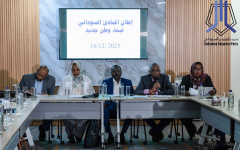

On December 16, Sudanese political parties, armed movements, civil society organisations, and prominent political figures signed a nine-point political roadmap in Nairobi, presenting it as a civilian-led initiative aimed at ending Sudan’s war and restoring a democratic transition.
Framed as an antiwar, pro-peace platform, it seeks to position civilians as a “third pole” against the two military actors in Sudan’s conflict: the Sudanese Armed Forces (SAF) and the paramilitary Rapid Support Forces (RSF).
Its authors say it represents an attempt to reclaim political agency for civilians after months of marginalisation by armed actors and foreign mediators, even though the declaration does not outline any concrete steps towards military reform.
The roadmap reignited longstanding debates within Sudanese political and civic circles about representation, legitimacy, and the persistent dominance of elite-driven civilian politics.
The roadmap
The Nairobi declaration emerged after a statement released by the Quad – Egypt, Saudi Arabia, the United Arab Emirates (UAE), and the United States – in September.
The Quad statement called for an immediate three-month truce to lead to a permanent ceasefire, humanitarian access to help civilians, and the creation of a political process for a civilian transition.
It also emphasised excluding remnants of former President Omar al-Bashir’s regime and reforming Sudan’s security forces under civilian oversight, all points that the Nairobi declaration echoed.
The Nairobi signatories included the National Umma Party, the Sudanese Congress Party, civil society organisations – including the Darfur Lawyers Association and the Coordination of Internally Displaced Persons and Refugees – and the Sudan Liberation Movement (SLM-AW) led by Abdelwahid al-Nur.
Former Prime Minister Abdalla Hamdok, who led Sudan’s transitional civilian government from al-Bashir’s overthrow in 2019 until the October 2021 military coup by the SAF and the RSF working in concert, also signed the declaration.
It was likewise endorsed by al-Nur, longtime leader of the SLM-AW armed group that controls Jebel Marra in Darfur and has historically rejected what he describes as “elite-driven” political settlements.
Falling short
Sudanese researcher Hamid Khalafallah told Al Jazeera that despite the intent to present a civilian leadership, the declaration falls short of reflecting Sudan’s broader civic movement.
The Nairobi coalition, he argued, mirrors earlier civilian formations that failed to connect with Sudanese citizens, particularly those most affected by the war.
“It’s in many ways a reproduction of former groups that have … struggled to represent the Sudanese people,” he said. “It’s still very much an elite group that does politics in the same way they always have.”
Although resistance committees – neighbourhood groups that emerged from Sudan’s protest movement and helped topple al-Bashir in 2019 – were referenced in the declaration, no committees formally endorsed or signed it.

Drafts were reportedly shared with some grassroots groups, but the process advanced without waiting for collective deliberation – reinforcing concerns that civilians on the ground remain politically instrumentalised rather than empowered.
While al-Nur’s participation was hailed by some as a breakthrough, Khalafallah questioned the underlying motivation, arguing that his incl