
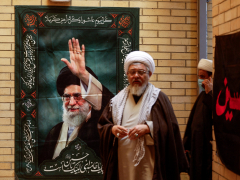

The killing of Ayatollah Ali Khamenei in US-Israeli air attacks has thrust Tehran to a pivotal crossroads as the ruling establishment looks to pick the late supreme leader’s successor.
Several senior leaders close to Khamenei were also killed in the attack, including his top security adviser Ali Shamkhani and Islamic Revolutionary Guard Corps (IRGC) commander-in-chief Mohammad Pakpour.
Tehran on Sunday targeted more sites in Gulf countries in retaliation as it vowed to avenge the killing of Khamenei. Meanwhile, United States President Donald Trump has warned against the retaliatory attacks and suggested that the strikes on Iran would continue.
The US-Israeli attacks were launched on Saturday despite several rounds of diplomatic engagement with Tehran that raised hopes of a deal on its nuclear programme.
The assassination of Khamenei, who took power in 1989, has left Iran’s top leadership to prepare for the transfer of power at a time when the US, the world’s strongest military power, has pledged to dismantle the ruling structure established following Iran’s 1979 revolution.
So, who will be the next supreme leader of Iran? And how will he be chosen?

How is the supreme leader selected?
Iran’s supreme leader is selected by the Assembly of Experts, an 88-member clerical body elected by the public every eight years.
Candidates who run for the Assembly must first be vetted and approved by the Guardian Council, a powerful oversight body whose members are partly appointed by the supreme leader himself.
When the position becomes vacant, due to death or resignation, the Assembly of Experts convenes to choose a successor. A simple majority is sufficient to appoint the new supreme leader.
As per Iran’s constitution, the candidate must be a senior jurist with deep knowledge of jurisprudence in Shia Islam, as well as qualities such as political judgement, courage, and administrative capability.
Earlier, there had been only one other transfer of power in the office of the supreme leader of Iran, when Grand Ayatollah Ruhollah Khomeini, the leader of the Islamic Revolution, died at age 86 in 1989.

What happens in Iran during a leadership vacuum?
Article 111 of Iran’s constitution mandates that a temporary council handle duties until a new supreme leader is elected.
That council will include President Masoud Pezeshkian, Supreme Court Chief Justice Gholam-Hossein Mohseni-Ejei, and a cleric from the Guardian Council, according to Iranian media. Ayatollah Alireza Arafi from the Guardian Council, 67, was on Sunday appointed to the three-member temporary council.
They will lead the country until the assembly formally picks the new supreme leader.
Iran’s security chief and a close confidante of the late Khamenei, Ali Larijani, said on Sunday that the transition process is under way.
Luciano Zaccara, a research associate professor in Gulf politics at Qatar University, told Al Jazeera that Iran’s political system has been prepared for the current situation, knowing that Khamenei’s assassination was a real possibility.
“Trump wants to get the best deal possible, but the method he’s using to get that deal is to annihilate or destroy as much as he can,” Zaccara said. “This is the way to impose conditions, not to negotiate anything. Trump wants a surrender of the regime, not a change.”
To avoid a vacuum of power, the late Khamenei kept replacements for all the officials eliminated in the last few months ready, and made sure to put in a structure, Zaccara told Al Jazeera.
“The structures remain, the line of power [and] the line of command remain in place,” he said.

Who is the supreme leader of Iran?
The supreme leader is the top position in the Islamic Republic’s political and religious hierarchy under the velayat-e faqih system – the principle of the guardianship of the Islamic jurist.
He is essentially the commander-in-chief of the armed forces and the final word in the country – and appoints key judicial, military, and media officials. He also leads the mighty IRGC.
Here are the contenders for the top job in Tehran
