
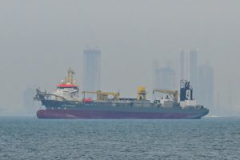

The United Arab Emirates and Kuwait started reducing oil production, as the near-closure of the crucial Strait of Hormuz ripples through energy markets and affects global supply.
Abu Dhabi National Oil Co. is “managing offshore production levels to address storage requirements,” the company said in a statement, without giving details. Kuwait Petroleum Corp. said it was lowering production at both its oil fields and refineries after “Iranian threats against safe passage of ships through the Strait of Hormuz.”
The war in the Middle East has all but closed Hormuz, the narrow waterway linking the Persian Gulf to the open seas, to maritime traffic following Iranian threats to shipping. That’s clogged up exports from the world’s top oil-producing region and helped drive prices in London to the highest close in more than two years at almost $93 a barrel, sending consumers searching for alternatives and threatening to push global inflation higher.
Kuwait’s oil cutback started with about 100,000 barrels a day as of early Saturday and is expected to almost triple on Sunday, with further gradual reductions depending on storage levels and the status of Hormuz, a person with direct knowledge of the plan said, asking not to be named because the details are private.
The UAE, which pumped more than 3.5 million barrels a day as OPEC’s third-biggest producer in January, is using export capacity that bypasses the Strait of Hormuz, and its international storage facilities, to ensure supply to global markets. Adnoc operates a 1.5 million barrel-a-day pipeline to Fujairah on the UAE’s western coast to avoid the strait. Adnoc said its onshore operations are continuing normally.
Cutbacks by the two OPEC members follow a swathe of others in the region. Iraq started holding back production earlier this week as storage tanks started filling up, while Saudi Arabia shut its biggest refinery and Qatar closed the world’s largest liquefied natural gas export plant after drone attacks.
Force Majeure
Kuwait Petroleum declared force majeure — a legal clause allowing a company not to fulfill contractual obligations because of circumstances outside its control — on sales of oil and refinery products, according to a notice seen by Bloomberg.
The country produced about 2.57 million barrels a day of oil in January, according to data compiled by Bloombe