
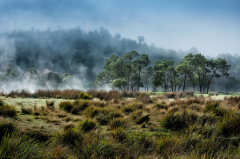

Explore the meaning of wilderness, its global decline, Indigenous stewardship and the transformative power of personal rewilding.
In Europe during the Middle Ages, small pockets of forest lay beyond the familiar homes and fields. Those areas were known in Old English as wildeornes, derived from the word wildeor, meaning a “self-willed” (wild) beast.
Some of the earliest references to wilderness are found in the Bible, where it tended towards arid semi-desert, a place for outcasts and mystics. John the Baptist preached in the wilderness of Judea, and Jesus fasted there for 40 days as a preparation for his ministry. Wilderness was where encounters with God’s manifestations often took place, such as Moses and the burning bush, and the Israelites being guided by a pillar of cloud and fire.
Time spent “in the wilderness” often refers to politicians who are, for the foreseeable future, removed from the levers of power. It carries additional overtones of facing adversity and doing some soul-searching.
Today, attitudes towards wilderness have radically changed, with many people actively choosing to be in such areas rather than away from them. Instead of being viewed as a source of danger, wilderness is now recognised for its often-rich biodiversity. Such natural expanses can represent a refuge from the less pleasant aspects of the human world such as pollution and noise.
This shift can be traced back to the second half of the 19th century, especially in the United States, when the groundwork was put in place for the modern conservation movement. On the agenda were protection of nature and the creation of national parks, the first being Yellowstone in 1872. This precedent eventually led to the Wilderness Act being passed in 1964 under US president Lyndon B. Johnson.
Identifying and protecting it
Internationally, there is no consensus on the definition of wilderness. A rough approximation would be “large natural areas of land that have not been significantly modified by the impact or activities of modern society”. These areas rarely have permanent human habitation, with the exception of indigenous dwellings in some large expanses of intact tropical forest.
Australia has so far omitted to draw up a national wilderness definition. The Commonwealth’s Environmental Protection and Biodiversity Conservation (EPBC) Act does not even mention it, which suggests a reluctance to take a strong and clear position. Definitions vary from state to state, and both New South Wales and South Australia have their own wilderness protection legislation.
If asked to visualise wilderness, many people are likely to think of a swathe of forest. Yet it can involve a range of other biomes. Australia’s wilderness largely consists of desert, savannah in the north and the Great Western Woodlands in the south of Western Australia. It also includes comparatively smaller areas of forest such as that in Tasmania’s south-west.
New Zealand has gone to the other extreme by being highly prescriptive. To be treated as wilderness, a stretch of land needs to require at least one day to reach on foot from the nearest outpost of civilisation, at least two days’ walk to cross and it will generally be at least 20,000 hectares in size. There are 11 designated areas, all with legal protection, four in the North Island and seven in the South Island.
In 2018, research by University of Queensland (UQ) and the Wildlife Conservation Society (USA) identified five countries that collectively contain about 70 per cent of the world’s remaining wilderness outside Antarctica. These are, in order of wild land area, Russia, Canada, Australia, the US (chiefly Alaska) and Brazil. In all, wilderness represents an estimated 23 per cent of the planet’s land surface. Lead author James Watson from UQ called for a prohibition on industrial-scale developments, such as mining, in these areas.
It was also estimated that between 1993 and 2016 more than 10 per cent of the world’s land-based wilderness was lost, with particular hotspots being rainforest areas in the Amazon basin and Central Africa. James Watson warned that within a century, there may be no globally significant wilderness areas left. Agriculture is responsible for far more forest loss than any other sector, with particular culprits being beef, palm oil, soya, cacao and coffee.
Links to tribal peoples
Indigenous groups inhabit some of the planet’s most biodiverse areas and are often considered as wilderness guardians. According to a United Nations study, 45 per cent of intact forests in the Amazon are in indigenous territories. Rather than being perfectly natural, it has been found that some wild areas, including tropical forest and the western deserts of Australia, have been managed over a long period of time by its indigenous inhabitants.
Forested tribal territories can be subject to logging and other destructive incursions, especially when they are yet to be officially demarcated. Over the past few years, in the Malaysian province of Sarawak, members of the Penan community have periodically maintained road blockades to prevent logging companies from destroying parts of the proposed Upper Baram Forest Area protection zone. This large area of more than 2800 square kilometres contains villages from four different tribes and represents the largest remaining area of unprotected primary rainforest in the province.
The management of designated wilderness areas sometimes had a dubious colonial element, especially in how it addresses the issue of human occupation. The archetypal wilderness has usually been seen as a swathe of unblemished nature, which excludes scope for human settlement. The US, in particular, has a history of removing indigenous tribes from these areas, such instances include Yosemite, Yellowstone and Glacier National Park in Montana. These evictions were additionally destructive because they erased living examples of humans sustainably inhabiting these environments for long stretches of time.
Similar issues involving protected areas have also occurred in countries such as the Democratic Republic of the Congo, where there has been a pattern of serious human rights abuses tied to projects backed by the World Wildlife Fund and others run by the conservation body African Parks. This syndrome has been dubbed “fortress conservation” by the indigenous rights advocacy group Survival International. For indigenous peoples, a good outcome is for them to have an important stakeholder role in sustainably managing and protecting the wild areas with which they have a traditional connection.
Human experience of wilderness
Many people who enter a wilderness area tend to experience a range of reactions that can include a sense of remoteness, an attunement to silence or natural sounds, appreciation of spectacular sights and feelings of awe. Mental chatter often stops and any thinking becomes more right-brained and liable to yield insights or inspirational ideas. One 2012 US study found that four days spent in a wilderness environment improved cognitive function and creativity.
This overlaps with the experience of forest bathing, also known as shinrin-yoku, a practice that originated in Japan in the 1980s and has since spread to other countries. It involves walking in wooded environments and is good to combin