
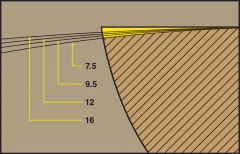

What does fretboard radius mean, and how does a 12-inch radius differ from a 16-inch one?—Hank Tortora
The term fretboard radius describes the curvature of the playing surface of the neck. Nearly all steel-string guitars have fretboards that have a crowned center—thickest in the middle, and slightly thinner along the edges. This is meant to make the neck easier to play and more friendly to the fingers, though it’s worth noting that classical guitars nearly always have flat fretboards, which seems to present no hindrance to highly technical playing.
The numbers used to describe radius are a measurement of the theoretical circle defined by the fretboard curve. If you were to trace the curvature of the fretboard, and project that same curvature beyond the neck itself, it would form a circle whose radius matched the specified number. Or, to put it another way, if you had a perfect circle of fretwire with a diameter of 24 inches, then a piece cut from that wire would perfectly fit the curvature of a 12-inch fretboard radius.
A smaller radius will have a more pronounced curvature. This is most often encountered on vintage or vintage-spec Fender-style guitars with their 7.25-inch radius. This is substantially rounder than most modern guitars and can present issues with playability, particularly for players who like to bend strings. You can visualize these issues easily by taking a can, bottle, or any other cylindrical object and a straightedge or ruler. Lay the ruler along the can, parallel to its long axis, and you’ll see that it touches along the entire length. This means that the can’s surface would be perfectly level relative to the ruler, just as we hope our frets will be relative to the strings.

But the problem arises because this perfect surface only exists when the ruler is parallel to the can—as soon as you pivot the ruler at all, it begins to rock around on a single point on the can’s surface. Because the nut is narrower than the bridge,