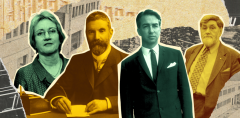

Australia has a fine tradition of unconventional politicians at all levels of government. Multiple examples probably spring to mind immediately.
But in researching this piece, I went down a wacky rabbit hole. It turns out there are lesser-known characters in the annals of history that deserve some time in the spotlight.
From particularly well-dressed pioneers to founders of micronations, here are some of Australia’s most eccentric politicians.
But who counts as ‘eccentric’?
What do we really mean by “eccentric”? According to the Cambridge Dictionary, the term describes someone who is “strange or unusual, sometimes in a humorous way”.
For our purposes here, a deep commitment to long-term oddity is vital – a one-off bizarro act isn’t enough.
You’ll notice there are very few women politicians described as eccentric. This is partly because historically the vast majority of state and federal MPs have been men, and partly because we (the public) are more accepting of eccentric men in political office, while women are held to a different standard.
It’s also a very fine line between being eccentric and being problematic or offensive. Many MPs have fallen foul of that line and so won’t be included here.
With all that in mind, I looked beyond the usual cast of onion-eaters, hat-wearers, Jurassic Park fans, and dog-threateners to find some of our lesser-known rum’uns.
Alfred Deakin
Many will know Deakin as one of the architects of Australian federation, the country’s second prime minister, and a strong advocate of racist policies.
What’s less well-known is that over a period of 13 years – including while he was prime minister – Deakin regularly published articles and letters anonymously in various newspapers.
Often written under the byline “From our special correspondent”, Deakin’s missives have been described as “vivid in style, intelligent in comment, relatively free from bias and mildly critical of himself on occasions”.
Deakin was also deeply interested in Muscular Christianity and spiritualism – he attended seances as a young man – and wrote poetry and plays throughout his life.
John the Duke of Avram
Born as John Charlton Rudge, “His Grace, the most Noble Duke of Avram” was a Liberal MP in Tasmanian parliament between 1989 and 1992 and later a deputy mayor in the state’s south.
In the early 1980s, the Duke had founded the Grand Duchy of Avram, a micronation with its own Royal Bank, to bring his PhD thesis on central banks to life.
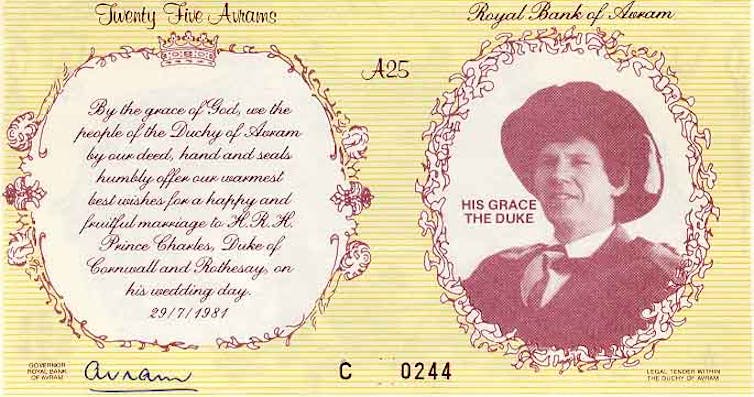
Grand Duchy of Avram
The Duchy never claimed any physical territory – and the Duke later said the micronation doesn’t exist – but the bank briefly opened a branch in Tasmania that issued coins and notes.
The federal government took the bank to court several times, but lost.
Kezia Purick
Purick was a Northern Territory MP from 2008 to 2024, first as part of the Country Liberal Party and later as an independent.
Down the years she made headlines for spending taxpayers’ money on booze, the corrupt use of public resources to stymie the creation of a new political party, resuscitating a chicken and catching a python.
Purick reserved some of her particularly colourful language for the late former federal minister Kevin Andrews. When he made headlines after saying that de facto couples should get married to protect their relationships and children, she called him a “pooncy, pasty-faced person” and implied she’d take to him with a device used for castrating young bulls if he turned up in her electorate.
Don Dunstan
Known for his progressive politics, dapper style and bisexuality, Dunstan was a revolutionary figure in South Australian politics. As premier in the late 1960s and 70s, he led a government that reformed Aboriginal land rights, decriminalised male homosexuality and put in place environmental protections.
And he did all this while turning out immaculately in safari suits, floral shirts, and – on a day that has gone down in Australian political folklore – tiny, bright pink shorts.
While he was premier, Dunstan also took up surfing and wrote a cookbook. After retiring from politics he hosted a TV