
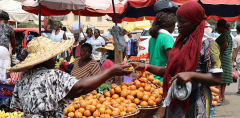

The informal economy is the basis of everyday economic life across sub-Saharan Africa. In Ghana, as in many low- and middle-income contexts, a lot of retail trade, food distribution, artisanal production and service provision happens outside formal regulatory frameworks.
Women occupy a prominent position in this world. They trade in open-air markets, process and sell foodstuffs, produce garments, provide hairdressing services and manage micro-enterprises that sustain households and anchor local economies.
Many do this work because they haven’t been able to get an education, a formal job or formal finance.
The informal economy is easier to enter – but also less secure. Enterprises tend to work without firm tenure, enforceable contractual protections or social insurance mechanisms. Income streams are volatile, exposure to risk is routine and it’s difficult to expand the business.
Despite these challenges, women’s informal enterprises play an important developmental role. They generate income where few alternatives exist, finance children’s education and contribute to local supply chains.
Public debates often portray them as vulnerable victims of poverty or as heroic symbols of resilience.
Both pictures oversimplify a far more complex reality.
We are researchers specialising in gendered entrepreneurship and informal economies. We conducted a study to explore how women in Ghana with low or no formal education sustain businesses where they are at a disadvantage, and how they deal with being portrayed as “weaker vessels”.
The research sheds light on what entrepreneurship looks like when resources are scarce, institutions are fragile and gender norms remain powerful. Our findings show resilience, as well as the hidden costs of survival in an economy where formal support systems are largely absent.
Our findings suggest that by supporting women in Ghana’s informal economy, policymakers can strengthen local markets, reduce economic precarity and enhance inclusive economic growth. Informal enterprises are deeply embedded in broader supply chains and community networks. Recognising and supporting them can increase productivity, stabilise livelihoods and create spillover benefits for the wider economy.
Life on the ground
We interviewed 21 women in southern Ghana and observed market spaces. The women were invited to share stories of actions they believed had enabled their businesses to survive despite limited resources.
These conversations highlighted the advantages associated with formal education, like access to networks, skilled labour and government programmes.
We also