
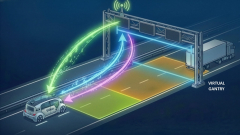

If you’re old enough to remember stopping to toss change into a big basket or exchange bills with toll booth attendants, then you’ve probably regarded E-ZPass as a huge leap forward. But the system isn’t nationwide, the toll-tags don’t always work in a glovebox or through a heated windshield, and there can be lots of “friction” in billing, dispute resolution, etc. A recent SAE standard, J3217, promises the next big upgrade to automatic toll collection—built-in C-V2X (cellular vehicle-to-everything) communications that promise greatly improved convenience, reliability, and privacy.
Today’s E-ZPass Tech
This relies on radio-frequency identification (RFID) tagging. This is “dumb” tech: A box broadcasts an ID, the toll gantry hears it (or doesn’t) with no handshake or acknowledgement. Higher speeds, device misalignment, or any number of other pitfalls force a fallback to reading your license plate and billing against that instead. And the toll boxes aren’t difficult to clone, which invites fraud.
Unfulfilled Promise: DSRC
Dynamic Short-Range Communications promised a two-way communications system that would fix most of the above issues, but it proved expensive to roll out, requiring new radios on every toll gantry and pricier car transponders. And while DSRC employed a very similar band of the 5.9GHz spectrum, DSRC and C-V2X “speak different languages.” Japan invested heavily in DSRC, but much of the rest of the world ended up reassigning some of DSRC’s spectrum to WiFi, spelling its doom.
PC5—a Cellular Sidechannel
In 2022, SAE published J3217, which spelled out how the same cellular modems cars increasingly employ to manage in-car telematics and WiFi can also serve as the in-car transponder for electronic fee collection and myriad other V2X safety purposes. It does this by communicating directly with roadside equipment, independent of the cellular towers. The communications protocol is “3GPP LTE-V2X PC5 sidelink,” which operates in the 5.9GHz ITS band, utilizing the 4G and 5G cellular protocols. These bands are both expected to stick around for a long time (perhaps through 2040), leveraging 5G for high-bandwidth stuff like streaming 4K video, and 4G for smaller data streams.
This system is fully integrated into the car, with communications happening via a shark-fin or windshield-mount antenna, and transactions are confirmed on the infotainment screen. No more poorly fitting plastic transponders stuck to the windshield, maybe beeping to tell you they just registered a toll collection.
No Cellular Contract Needed
The handshake between the car and a roadside unit happens via the PC5 sidelink. Those signals use a unique sliver of the 4G LTE spectrum and those communications are direct, device-to-device without relaying through a cellular tower (making them great for use in tunnels). Then from time to time, the system communicates via the mainstream 4G/5G cellular towers to get things like system updates and to receive “Security Credential Management System” pseudonym certificates. During these times communications happen kind of like how a cell phone with no SIM card can still make 911 calls.
Secure and Private
Instead of sharing a single, permanent digital ID (like a license pl