
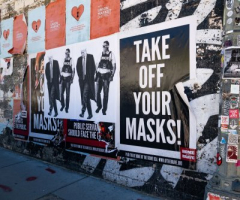

The city of St. Paul, Minn., has joined more than a dozen other state and local jurisdictions in seeking to enact legislation banning the wearing of masks by law enforcement agencies such as the federal Immigration and Customs Enforcement agency. File Photo by Annabelle Gordon/UPI | License Photo
ST. PAUL, Minn., Feb. 13 (UPI) — The city of St. Paul, Minn., which has been occupied by thousands of ICE agents from Operation Metro Surge, has joined a growing list of state and local jurisdictions around the country seeking to prevent federal immigration enforcement agents from wearing masks while carrying out aggressive sweeps and arrests, even though the legality of such bans remains in question.
Just before the Trump administration’s announcement Thursday of an imminent end to the operation in Minnesota, which resulted in the killings of two people, residents in the capital city of St. Paul emotionally testified in favor of a proposed new ordinance that would prohibit the use of masks by all law enforcement officers, including federal Immigration and Customs Enforcement agents.
The testimony came as Democratic city leaders, including St. Paul Mayor Kaohly Her and all seven council members, sought to join a growing list of at least 17 states, as well as local jurisdictions such as Los Angeles County, Denver and Portland, Ore., in introducing legislation banning law enforcement agents from wearing masks — even though those bans are already facing legal challenges from President Donald Trump’s Department of Justice.
Democrats in the U.S. Senate, who have characterized ICE as an “out-of-control paramilitary force,” are also demanding that its agents stop wearing masks — among other key reforms — as a price for continuing to fund the Department of Homeland Security and avoid a partial government shutdown.
Administration officials, however, insist masks are necessary to protect the agents from “doxxing,” in which their identities and other personal information are revealed online as they engage in street sweeps and heavily armed raids.
After 10 weeks of more than 2,500 masked agents roaming the streets of the Twin Cities over the vehement objections of state and local officials, White House border czar Tom Homan said Thursday Trump has agreed to withdraw them, leaving only a residual force behind.
He called the operation a “success,” claiming more than 4,000 arrests, although the number is impossible to verify.
But the operation resulted in the killings of two civilians by federal agents: Renee Good and Alex Pretti, both 37 years old. Their deaths and the White House’s characterizations of them as “domestic terrorists” sparked an intense worldwide backlash against ICE and contributed to Trump’s slipping polling numbers on the immigration issue.
The St. Paul anti-masking proposal states that “a law enforcement officer shall not wear a face covering or personal disguise that conceals or obscures their facial identity in the performance of law enforcement duties.”
It would apply to “any governmental department, agency, office or division with authority to detect and apprehend persons for violating federal, state or local laws,” including any federal law enforcement agency, such as ICE, as well as to any Minnesota agency or those of other cities or states.
The measure will come up for a final vote next week.
Council members listened as a stream of residents took the podium to describe how the wearing of masks by ICE agents while carrying out aggressive immigration sweeps of neighborhoods in St. Paul and Minneapolis as part of Operation Metro Surge has created fear, trauma and a sense of intimidation among those witnessing and caught up in them.
One city resident, who identified herself only as Haikka, told UPI she immigrated to the United States from a European country decades ago and is now a naturalized U.S. citizen. She said she supports the ban because the masks worn by ICE agents are part of what she sees as a “militarization” of law e