
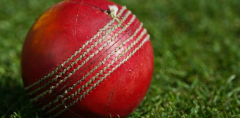

The game of cricket is believed to have originated in rural England sometime in the 16th or 17th century.
The earliest versions of cricket balls had no standard size, weight or stitching: they were handmade by locals and consisted of a round leather case filled with materials such as cork or wool.
As there were no set requirements or construction methods, each ball was different, and this affected how it bounced, moved and rebounded off the bat.
However, cricket spiked in popularity in the first half of the 18th century, which prompted consistency in the rules and equipment to ensure fairness and facilitate further growth of the game.
The modern cricket ball
Modern balls consist of four main components: a cork and twine (string) core, a leather casing, a raised middle section (the seam) with stitching on either side and a wax or lacquer coating.
Balls are either red (for long formats such as international Test matches), white (for shorter formats such as One Day Internationals or Twenty20 games) or pink (for day-night Tests and first-class games).
Read more:
Like night and day: why Test cricket changes so much under lights
The laws of cricket state that when new, the ball should weigh between 5.5 and 5.75 ounces (155.9–163 grams) and have a circumference of 22.4–22.9 centimetres.
For women’s cricket, the ball can weight slightly less (140–151g) and for junior cricket (under 13) even less again (133–144g).
A set of technical standards was formalised in 1994 which stipulate the mechanical requirements for factors such as hardness, to help different manufacturers produce balls with more consistency and ensure fairness across the globe.
So why are balls so hard?
Cricket balls are the product of centuries of tradition and the extreme physical demands of the game. They must be robust and hard-wearing, able to withstand repeated high-force impacts from both the bat and the pitch over the course of a match.
Consider the forces involved when a ball is struck by a bat.
Reasonable estimates of peak forces when the ball is struck by the bat are about 17 kilonewtons (the weight of 1,700 kilograms) – enough to lift a 1.7 tonne car off the ground.
The ball also repeatedly impacts the pitch at high speeds, experiencing shear forces that gradually wear its surface. On deteriorating pitches, this wear is even more pronounced.
In Test cricket, a single ball can be bowled up to 480 times (80 overs) before the fielding team is allowed to request a replacement.
While cricket ball construction has evolved over the past 300 years, its main elements have remained largely consistent.
The introduction of the seam – the raised stitching that runs around the ball’s circumference – and the practice of shining one side of the