

February 9, 2026
2 min read
 Add Us On GoogleAdd SciAm
Yellowstone’s earthquakes spark microbial boom deep underground
Earthquake swarms can supercharge microbial growth
By Damien Pine edited by Sarah Lewin Frasier
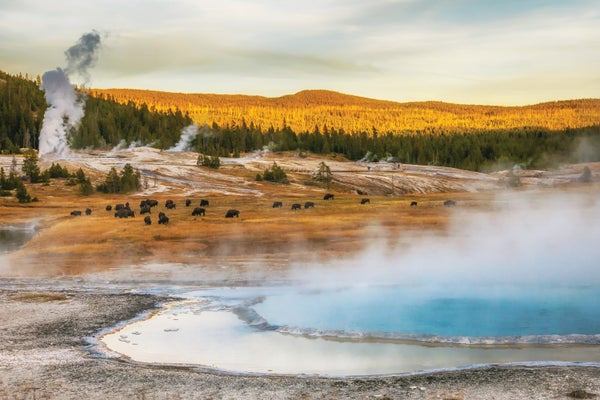
A swarm of 2,182 earthquakes at Yellowstone National Park was key for a new finding about microbes.
Cheryl Ramalho/Getty Images
With some luck, specialized equipment, a supervolcano and a narrow hole 30 stories deep, researchers demonstrated that earthquakes shake up more than just rocks—they also boost microbe populations living underground.
Up to 30 percent of life on Earth doesn’t ever see sunlight; instead these organisms get energy by chowing down on hydrogen generated through chemical interactions between water and rocks. Earthquakes fracture rocks, creating fresh reaction surfaces and shifting the pathways water travels along, which increase hydrogen production. For a study in PNAS Nexus, researchers tracked the effects of such shake-ups on microbes at the bottom of a 100-meter-deep borehole in Yellowstone National Park.
The scientists made a 10-hour round-trip trek to and from the test site seven times over seven months. There they collected samples of rock, dissolved gas and microbes, overcoming equipment malfunctions, logistical difficulties, and more along the way. The group was lucky enough to be taking measurements at just the right time—and in the ideal location—to perfectly catch the rise and fall of a rare “swarm” of 2,182 earthquakes. Yellowstone endures a lot of earthquakes, but swarms this powerful tend to occur every five to 10 years, says Montana State University geomicrobiologist Eric Boyd, the study’s lead author.
On supporting science journalism
If you’re enjoying this article, consider supporting our award-winning journalism by subscribing. By purchasing a subscription you are helping to ensure the future of impactful stories about the discoveries and ideas shaping our world today.
During the swarm, the amount of microbial life present increased by 6.5 times before dropping back to normal after the tremors subsided. Hydrogen levels also increased, and the types of microbes observed changed. “All the pieces fit together nicely,” Boyd says. “We put all of these data together, and we’re like, holy cow!”
The results might offer clues for finding life thriving under otherworldly surfaces, too. “Extrapolation to other planets and moons suggests that subsurface life might be most easily found in seismically active locations,” says Steven D’Hondt, who studies below-seafloor life at the University of Rhode Island and was not involved with the work. “It’s a wonderful study,” he adds.
Caroline Freissinet, an astrobiologist at French research institute LATMOS who was not involved with the work, says that although it’s a great result for understanding Earth, the study is unlikely to change much about the search for life on our nearest neighboring planet, Mars, because of its “hellish subsurface conditions.”
“Mars in the past was wetter,” she says, “but what would be left today of this temporarily enhanced activity, four billion years later?”
T